From Retrieval Motifs To SGD Circuit Selection
Nelson Alex
Living draft: 2026-04-11
This is an ongoing research report. It records the current state of the project, not a final paper claim.
Document Map
This page is the main public-facing paper draft.
Supporting docs:
- Checkpoint Analysis Plan: the checkpoint-level measurement design.
- Shared Feature Dynamics Plan: the feature-basis and feature-family analysis design.
Page-local figure assets live in:
assets/figures/
The deeper artifacts/ paths listed later are source artifacts and reproducibility pointers. Figures embedded in this page are copied into docs/assets/figures/ so the page can render from the docs/ folder.
Abstract
This project studies how a small decoder-only transformer forms retrieval circuits during plain autoregressive next-token training.
The previous study, Mechanistic Transparency, showed that small transformers repeatedly learn staged retrieval motifs rather than one fixed universal head graph. The strongest stable object in that work was a role-level retrieval/write motif, while exact head identity, birth timing, and matching-slot localization varied across seeds and curricula.
This paper starts at the remaining gap:
Why does SGD form one circuit family rather than another?
The current project builds a controlled stream-based symbolic key-value benchmark, trains a small decoder-only transformer, saves dense checkpoints, and builds a layered analysis stack that tracks behavior, residual states, heads, MLPs, shared features, feature families, candidate circuits, and gradient-linked birth factors.
Current supported result:
- useful behavior appears in stages
- the learned mechanism is dense rather than a single-neuron bottleneck
- upper-layer feature families expose candidate retrieval/write coalitions
- family7 at
layer_2_post_mlp, features27and54, is the strongest current generalizing candidate - family4, features
1and59, is a related but weaker sibling candidate - both candidates share traced component ancestry through
layer0_head3,layer0_mlp, and alayer2neuron group - family7 and family4 share a dense layer-0-heavy MLP-neuron coalition during the early
1750 -> 2500formation window - targeted neuron ablation at checkpoint
2500causally drops both family feature scores, but does not yet cleanly drop overall task behavior
Current negative result:
- the first transparent
candidate-birth-modeldoes not yet predict family7 over family4 from shared strict pre-birth evidence - this means the current “why” model is incomplete
- neuron-level coalition tracing alone is not enough to explain why SGD selects the final circuit
The paper should therefore be read as a live mechanistic research record. The project has moved from component observation into the harder mathematical question: how the dataset relation d(x, y) becomes attention geometry, MLP feature geometry, path-level logit contribution, and finally an SGD-selected internal circuit.
Claim Status Legend
Every major claim is marked with one of these statuses:
| status | meaning |
|---|---|
| Supported | Directly backed by current artifacts. |
| Current best hypothesis | Consistent with artifacts, but not yet proven. |
| Negative result | A test failed or contradicted the simple story. |
| Unsupported | Not yet established by the repo. |
| Next test | A concrete experiment needed next. |
One-Page Summary
Supported:
The project currently has a full end-to-end circuit-formation analysis stack:
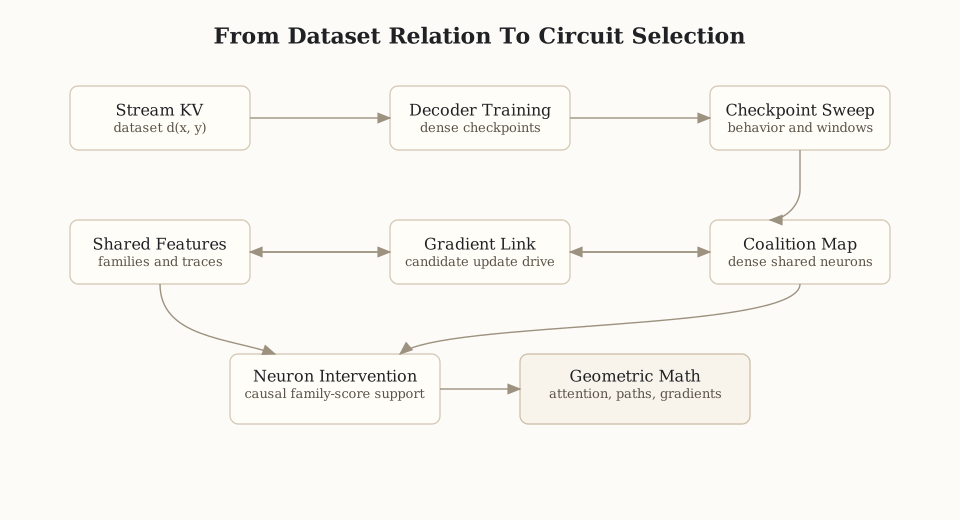
Current best hypothesis:
SGD first builds a shared dense retrieval/write coalition. Different feature families then become sibling branches of that coalition. Family7 appears to be the more generalizing branch; family4 receives strong feature amplification but generalizes much less. The shared coalition is real, but a neuron-list explanation is no longer enough: some neurons that look helpful by update geometry suppress the feature score at the current checkpoint, while some shared-negative neurons are strong current carriers.
Negative result:
The first birth model ranks family4 above family7 at the shared pre-birth cutoff, even though family7 becomes useful earlier and generalizes better.
Unsupported:
The repo does not yet support a final mathematical derivation of SGD circuit selection, attention retrieval geometry, or path-level logit decomposition.
Relation To The Prior Paper
The prior paper studied retrieval motif emergence in small transformers and reached this core conclusion:
small transformers repeatedly learn a staged retrieval motif,
not one fixed universal head graph.
That paper established several important facts:
- behavior, copy, routing, variable probes, and faithfulness do not birth in one universal order
- exact head identity is unstable across seeds
- the stable object is closer to a role-level motif than a fixed head graph
- the matching-slot computation is real but hard to localize cleanly
- dense and distributed structure blocks simple neuron-level explanations
Its explicit limits included:
- no explanation of why gradient descent prefers one retrieval motif over another
- no closed-form mathematical derivation of circuit formation
This project is the next step. It keeps the controlled retrieval setting, but changes the benchmark and tooling so the main object is not just the final circuit. The object is the training trajectory itself.
Main Research Question
The central question is:
Why does SGD form one circuit family over another?
Operationally, this becomes:
Given candidate circuit families c_1, c_2, ..., c_n,
can we predict before useful birth which one SGD will reinforce?
The first mathematical target was:
Delta S_c(t) ~= grad_theta S_c(theta_t) . Delta theta_t
where:
S_cis the score for candidate circuit or feature familyctheta_tis the model state at checkpointtDelta theta_tis the checkpoint-to-checkpoint parameter update
Under an SGD-like update:
Delta S_c(t) ~= -eta_t <grad_theta S_c(theta_t), grad_theta L(theta_t)>
That means a candidate should form when the update direction repeatedly aligns with the direction that increases that candidate, while also reducing training loss and avoiding excessive interference.
This is useful but not sufficient. The recent coalition and intervention results show that the same neuron set can support multiple candidate families, oppose a subfeature, and still leave task behavior partly compensated. The next mathematical target must move from a candidate-family score to a path-level explanation:
m_t(x, y) =
  logit_t(y | x) - logsumexp_{z != y} logit_t(z | x)
where m_t(x, y) is the correct-answer margin for a dataset relation d(x, y).
The circuit question becomes:
m_t(x, y) ~= sum_P C_P(theta_t, x, y)
where C_P is the contribution of a candidate computational path:
- dataset relation
- query/key attention geometry
- value-write geometry
- MLP feature geometry
- residual stream readout
- unembedding direction
The SGD selection question becomes:
E_D[Delta C_P]
  ~= -eta_t E_D[<grad_theta C_P(theta_t, x, y), grad_theta L(theta_t, x, y)>]
So the real target is no longer just “which family score increased?” It is:
Which path contribution aligns with the data-induced loss gradient,
and why does that path win over other possible paths?
Supported so far:
- the repo can measure candidate score movement across checkpoints
- the repo can measure projected update alignment with loss and feature-score gradients
- the repo can compare candidate families
- the repo can show dense shared neuron support and targeted causal feature-score drops
Unsupported:
- the repo cannot yet predict the correct candidate family before birth with the first simple factor model
- the repo cannot yet decompose the correct-answer margin into mathematical attention/MLP/readout path terms
Dataset Development Story
Rejected Initial Direction
Supported:
The earlier terminal-answer symbolic KV format was rejected because it made the mechanism too artificial.
Old shape:
SET ...
SET ...
QRY ...
ANS ...
Main problems:
- one obvious answer site
- answer behavior too separated from normal language-model training
- too much risk of format learning
- too little useful supervision inside the stream
- too little room for circuit competition
Current Benchmark
Supported:
The benchmark is now a stream-based symbolic KV task trained with ordinary next-token prediction.
Example:
<bos> W K00 V12 W K03 V04 R K00 V12 W K00 V07 R K03 V04 R K00 V07 <eos>
In this task:
W K Vwrites a value for a keyR K Vreads the current value for that key- overwrites force the model to retrieve the latest relevant value
- multiple read events appear inside one stream
- the model is trained on all next tokens, not only answer tokens
Benchmark config:
configs/benchmark/symbolic_kv_base.json
Generated data:
data/generated/symbolic_kv_stream_learnability
Current settings:
| field | value |
|---|---|
| keys | 8 |
| values | 128 |
| heldout answer-pair fraction | 0.1 |
| train/IID active keys | 2..3 |
| train/IID overwrite count | 8 |
| train/IID read count | 6..7 |
| structural OOD active keys | 4..5 |
| structural OOD overwrite count | 10..12 |
| structural OOD read count | 8..10 |
Dataset Sanity Checks
Supported:
From the generated benchmark metadata:
| check | value |
|---|---|
| exact-sequence overlap across splits | 0 |
| latent-program overlap across splits | 0 |
| heldout leakage outside heldout split | 0 |
first_value_for_key heuristic |
0.0 |
last_value_before_query heuristic |
0.0 |
strongest most_frequent_value_before_query heuristic |
about 0.146 |
Interpretation:
The benchmark is not solved by trivial sequence overlap or simple hand-coded retrieval heuristics.
Model And Training
Supported:
The reference model is intentionally small:
| field | value |
|---|---|
d_model |
128 |
n_layers |
3 |
n_heads |
4 |
d_ff |
512 |
| dropout | 0.0 |
| max sequence length | 96 |
| parameters | 626,048 |
Reference training config:
configs/train/symbolic_kv_generalization.json
Formation training config:
configs/train/symbolic_kv_formation.json
Reference Checkpoint
Supported:
The current selected reference checkpoint is:
- run:
artifacts/runs/symbolic_kv_heldout_generalization - checkpoint:
artifacts/runs/symbolic_kv_heldout_generalization/checkpoints/best.pt - step:
13000 - selection split:
heldout_pairs - selection metric:
answer_accuracy
Selected-checkpoint answer accuracies:
| split | answer accuracy |
|---|---|
| validation IID | 0.9578527137637138 |
| test IID | 0.9578204743320324 |
| heldout pairs | 0.873018247083458 |
| structural OOD | 0.5081577525661805 |
| counterfactual | 0.9599219453617532 |
Interpretation:
- IID behavior is strong enough for mechanistic work
- heldout-pair generalization is real
- structural OOD is not solved
- the checkpoint is a useful mechanistic reference, not a robust reasoning model
Why Token Accuracy Is Not The Main Metric
Supported:
Global token accuracy is misleading here because many write values are intentionally stochastic under the prefix. The model is not supposed to predict random write values.
Only about 12.75% of next-token targets are query-answer value tokens.
Therefore the main behavioral metrics are:
- answer accuracy
- heldout-pair answer accuracy
- structural OOD answer accuracy
- answer margin
- mechanistic localization and causal patch effects
Formation Run
Supported:
The current dense formation run is:
- run:
artifacts/runs/symbolic_kv_reference_formation - checkpoint directory:
artifacts/runs/symbolic_kv_reference_formation/checkpoints - checkpoint cadence: every
250steps - analyzed checkpoints:
64 - probe set:
artifacts/runs/symbolic_kv_reference_formation/analysis/probe_set.jsonl
The dense sweep found three main windows:
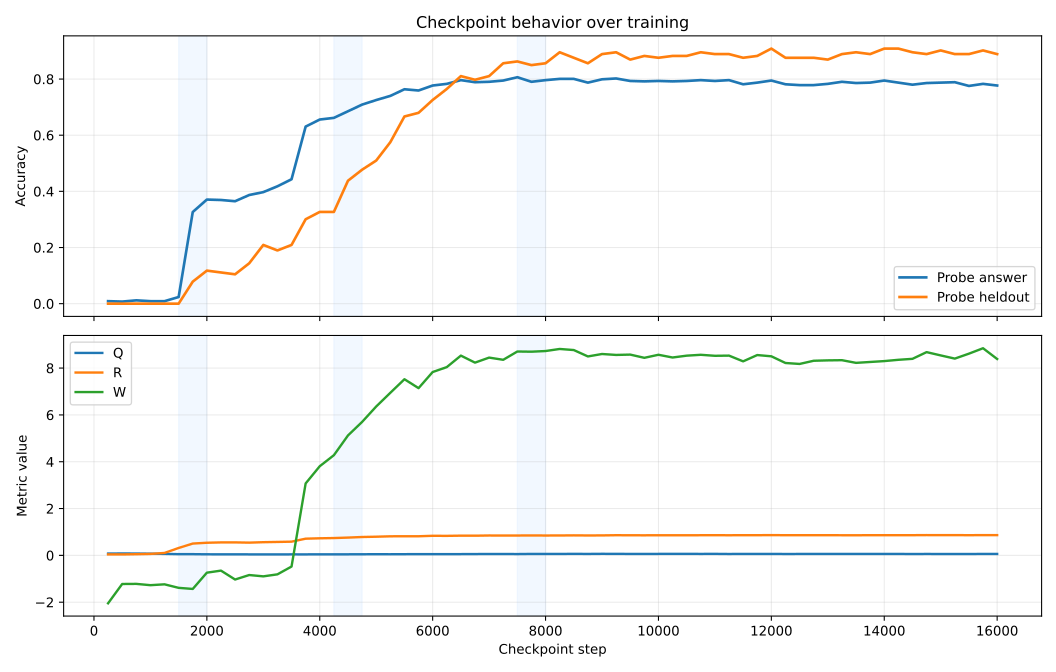
| window | steps | current interpretation |
|---|---|---|
| early birth | 1500-2000 |
first usable behavior appears |
| mid consolidation | 4250-4750 |
heldout-pair performance improves |
| late reorganization | 7500-8000 |
upper-stage representations reorganize |
Top sweep triggers:
| trigger | step |
|---|---|
| top answer gain | 1750 |
| top heldout gain | 4500 |
top Q gain |
7750 |
Current best hypothesis:
The mechanism forms in stages:
- lower-layer scaffold appears
- routing heads consolidate
- upper-layer MLP writes become usable
- late training refines top-layer writeout for heldout generalization
- continued training can overspecialize or rebalance the writeout
Tooling Stack
The tools are part of the research contribution. They turn checkpoint files into an explicit circuit-formation record.
Tool Dependency Graph
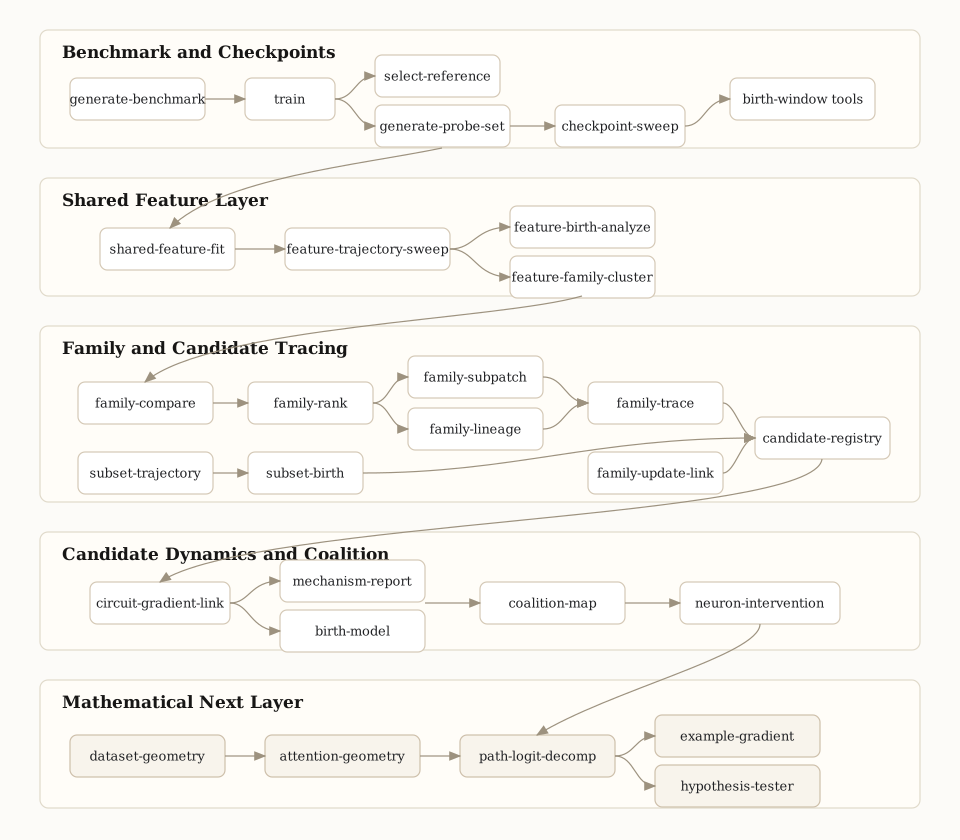
Current Tool Inventory
| tool | why it exists | current output type |
|---|---|---|
generate-benchmark |
create controlled train/test/OOD data | dataset directory |
train |
train small decoder-only model | checkpoints and metrics |
select-reference |
choose best completed run by heldout-aware policy | reference JSON |
generate-probe-set |
freeze small fixed examples for repeated checkpoint analysis | JSONL probe set |
checkpoint-sweep |
evaluate all checkpoints on fixed probes | checkpoint metrics JSONL |
birth-window-analyze |
identify major formation windows | birth-window report |
birth-window-compare |
patch/check selected source and target checkpoints | causal comparison report |
shared-feature-fit |
fit stable feature basis across checkpoints | shared basis |
feature-trajectory-sweep |
track feature metrics across checkpoints | feature trajectory JSONL |
feature-birth-analyze |
estimate individual feature births | birth report |
feature-family-cluster |
group features by trajectory similarity | family graph and plots |
feature-family-birth |
estimate family-level births | family birth report |
feature-family-rank |
select useful members inside one family | rank report |
feature-family-subpatch |
causally patch ranked feature subsets | patch report |
feature-family-lineage |
link feature subset to heads, MLPs, neurons | lineage graph |
feature-family-trace |
combine birth, rank, patch, lineage into one trace | trace report |
subset-trajectory |
track selected feature coalition over time | subset trajectory |
subset-birth |
estimate subset birth and useful birth | subset birth report |
family-update-link |
relate subset changes to component update shares | update-link report |
candidate-circuit-registry |
canonicalize candidate families for later analysis | candidate registry |
circuit-gradient-link |
connect checkpoint updates to loss and feature-score gradients | gradient-link report |
candidate-mechanism-report |
summarize what formed and which components contributed | mechanism report |
candidate-birth-model |
test whether pre-birth factors predict candidate birth | birth-model report |
candidate-coalition-map |
test whether candidate families share the same supporting MLP neurons | coalition report |
candidate-neuron-intervention |
causally ablate shared/specific/conflict coalition neurons | intervention report |
dataset-geometry-report |
planned: make the symbolic relation d(x, y) explicit |
not built |
attention-geometry-trace |
planned: trace QK retrieval and OV write geometry across checkpoints | not built |
path-logit-decomposition |
planned: decompose answer margin into computational path contributions | not built |
example-gradient-geometry |
planned: compare per-example gradient alignment and conflict | not built |
mechanism-hypothesis-tester |
planned: test explicit mathematical circuit hypotheses | not built |
Supported:
This stack exists and runs end to end on the current traced family7/family4 artifacts.
Unsupported:
It does not yet produce a final complete circuit decomposition. The next tools must connect dataset geometry, attention geometry, path contributions, and SGD gradient alignment.
Shared Feature Layer
Supported:
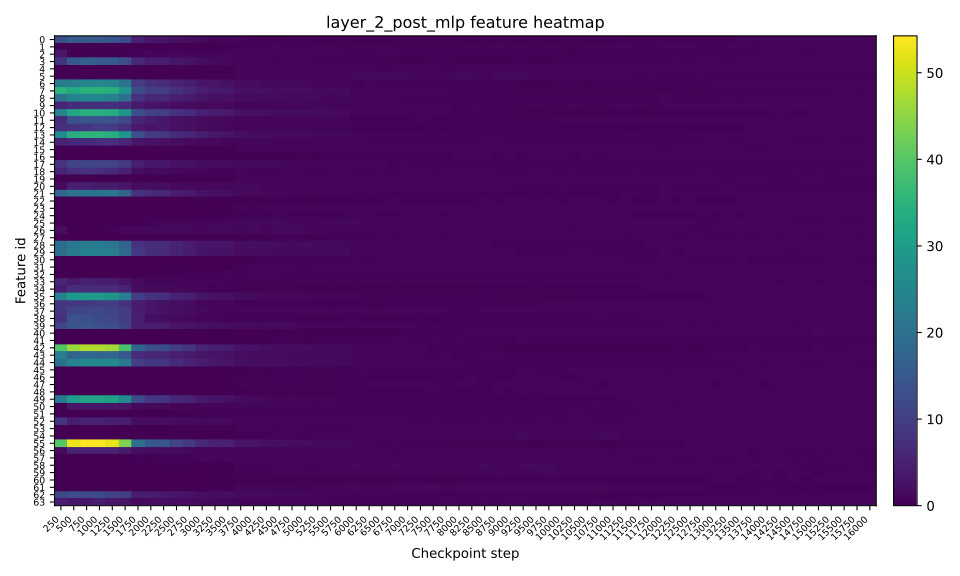
Shared feature bases exist for:
layer_2_post_mlpfinal_norm
Both use:
64features- input dimension
128 - fit checkpoints:
7500,14000,16000
Current fit metrics:
| stage | explained variance | active fraction | reconstruction loss |
|---|---|---|---|
layer_2_post_mlp |
0.7457791864871979 |
0.5410973429679871 |
0.2546698749065399 |
final_norm |
0.7311904430389404 |
0.5383508801460266 |
0.26917073130607605 |
Important caveat:
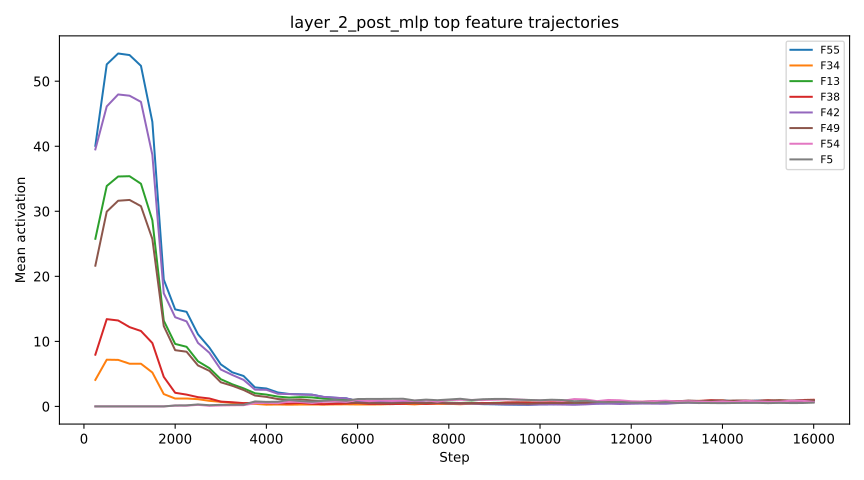
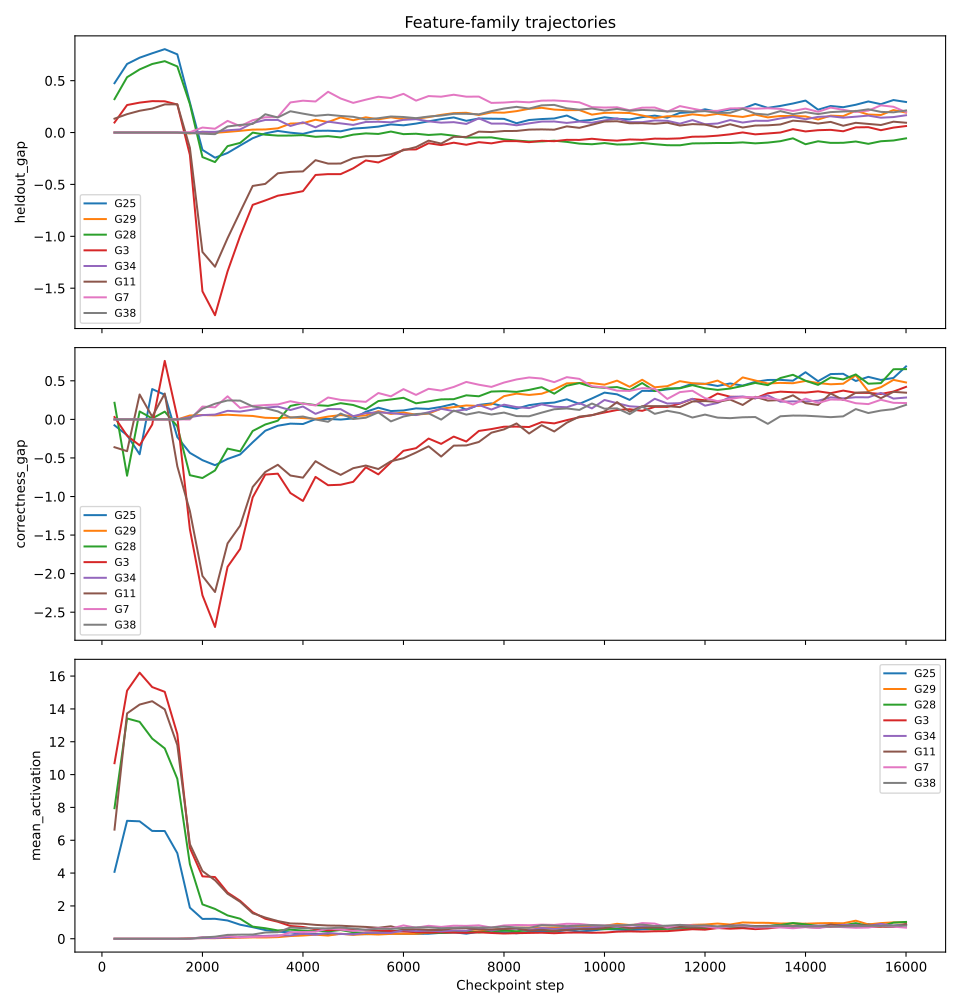
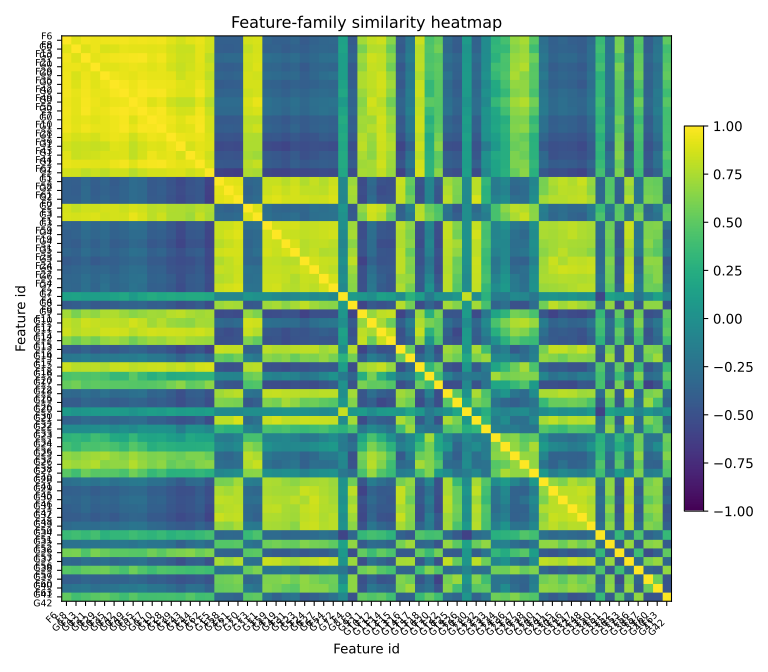
The current shared-feature basis is useful for tracking, but too dense for strong semantic feature claims. A feature ID is currently an analysis coordinate, not automatically a natural mechanistic atom.
Current Candidate Families
The strongest current traced comparison is between family7 and family4 at layer_2_post_mlp.
Mechanism report:
artifacts/runs/symbolic_kv_reference_formation/analysis/traced_candidates/layer2_family7_family4/mechanism_report/candidate_mechanism_report.md
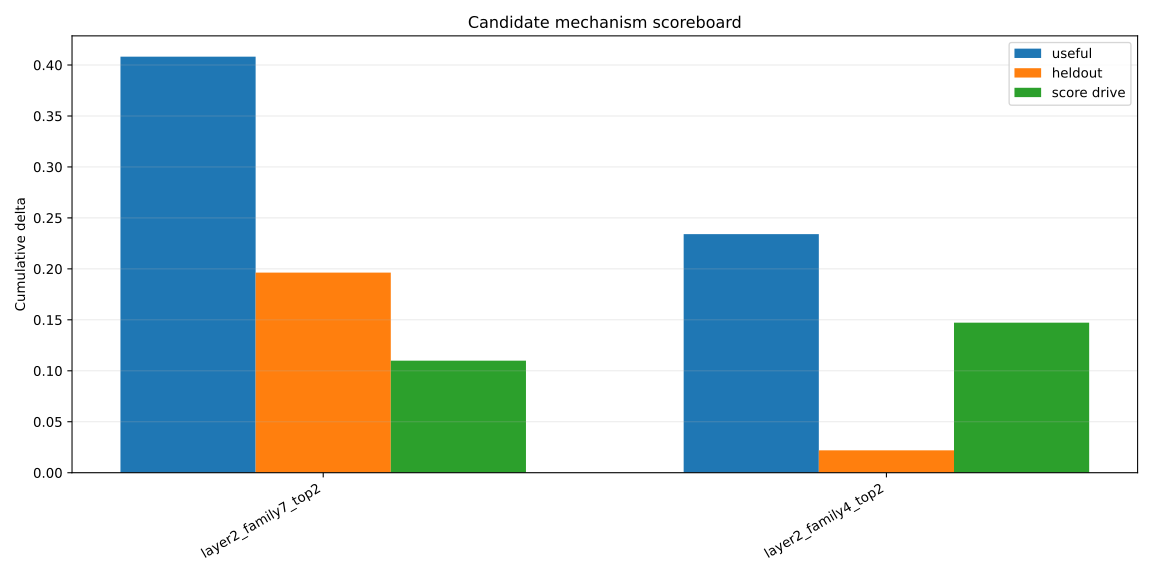
Candidate Scoreboard
Supported:
| candidate | features | useful delta | heldout delta | traced feature-score drive | status |
|---|---|---|---|---|---|
layer2_family7_top2 |
27, 54 |
0.40821056067943573 |
0.19631874561309814 |
0.10995836968906202 |
sgd_supported_generalizing_candidate |
layer2_family4_top2 |
1, 59 |
0.23405300080776215 |
0.021932989358901978 |
0.14723929510814068 |
sgd_supported_generalizing_candidate |
Interpretation:
- family7 is the stronger current candidate because it has meaningful heldout gain
- family4 is real, but weaker and less generalizing
- family4’s score movement does not convert into heldout improvement as cleanly
Component Responsibility
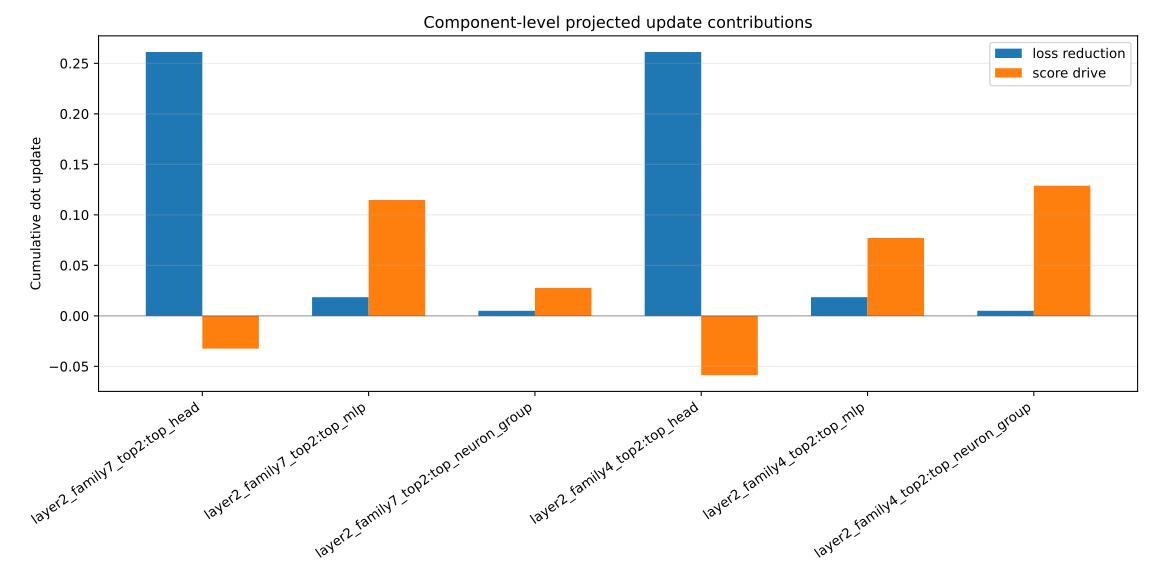
Supported:
Both families share the same top traced component groups:
layer0_head3layer0_mlplayer2neuron group180, 121, 427, 39
Component interpretation:
| component | family7 score drive | family4 score drive | interpretation |
|---|---|---|---|
layer0_head3 |
-0.0324539 |
-0.0587729 |
helps loss route, suppresses/rebalances these feature scores |
layer0_mlp |
0.114723 |
0.077158 |
main traced family7 formation component |
layer2_neurons[180,121,427,39] |
0.0276895 |
0.128854 |
strong family4 amplification/readout shard |
Current best hypothesis:
layer0_head3 is not the direct birth source. It is part of a task-loss route. The feature-family formation signal is more visible in layer0_mlp, while the layer2 neuron group amplifies or reads out the family, especially family4.
Competition
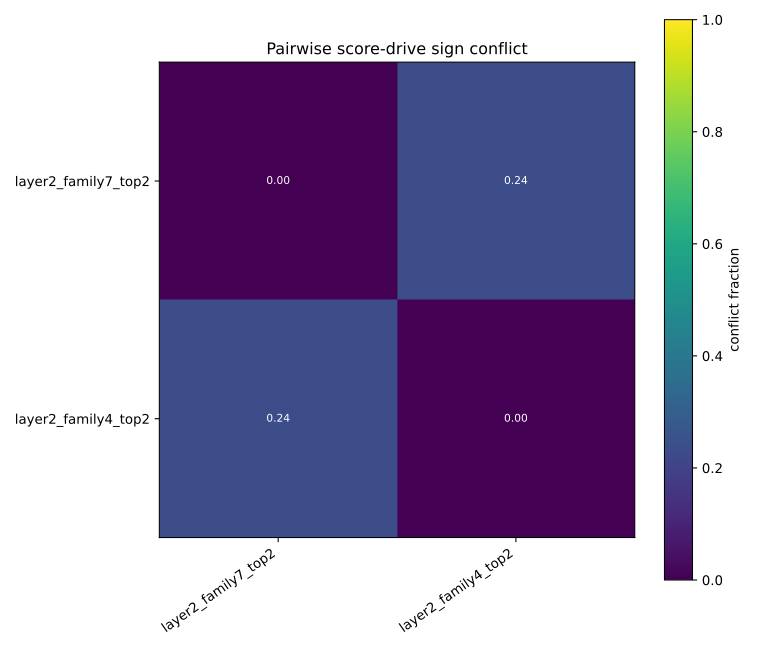
Supported:
Family7 and family4 are not clean competitors.
Pairwise relationship:
| metric | value |
|---|---|
| score correlation | 0.7663 |
| useful correlation | 0.6062 |
| score sign conflict fraction | 0.2381 |
| simultaneous useful gain fraction | 0.2857 |
Interpretation:
They mostly move together. This supports the dense-coalition view: the model is not forming two clean isolated circuits, but sibling feature families inside a shared module.
Patch Caveat
Negative result:
The 7500 -> 14000 subpatch is negative for both family7 and family4 subsets.
Interpretation:
This does not reject family7. It means 7500 -> 14000 is the wrong causal window for birth. By then family7 has already formed and is being compressed or rebalanced.
Next test:
Patch earlier formation windows:
| candidate | source -> target |
|---|---|
| family7 | 1750 -> 2500 |
| family7 | 2750 -> 3750 |
| family7 | 4250 -> 4500 |
| family4 | 2000 -> 2500 |
| family4 | 3500 -> 4500 |
| family4 | 5500 -> 6000 |
The Why Gap
Supported:
The current analysis can say:
- when candidate families appear
- which components are linked to them
- whether their trajectories help answer or heldout behavior
- whether checkpoint updates align with candidate feature-score gradients
Unsupported:
This does not yet answer:
Why did SGD select family7 as the more generalizing branch?
The distinction is:
| current stack | missing why model |
|---|---|
| observes candidate formation | predicts candidate formation before birth |
| traces components after candidate selection | compares possible candidates before selection |
| reports useful movement | explains why that movement was favored by SGD |
| measures gradient alignment | tests whether alignment predicts birth order |
Candidate Birth Model
The new candidate-birth-model tool is the first attempt to move from observation to prediction.
It consumes:
- candidate registry
- circuit-gradient-link output
- subset birth labels
- subset trajectories
It reports:
- actual birth or useful-birth step
- prediction cutoff
- post-birth leakage flag
- factor decomposition
- predicted birth rank
- actual birth rank
- visual factor plots
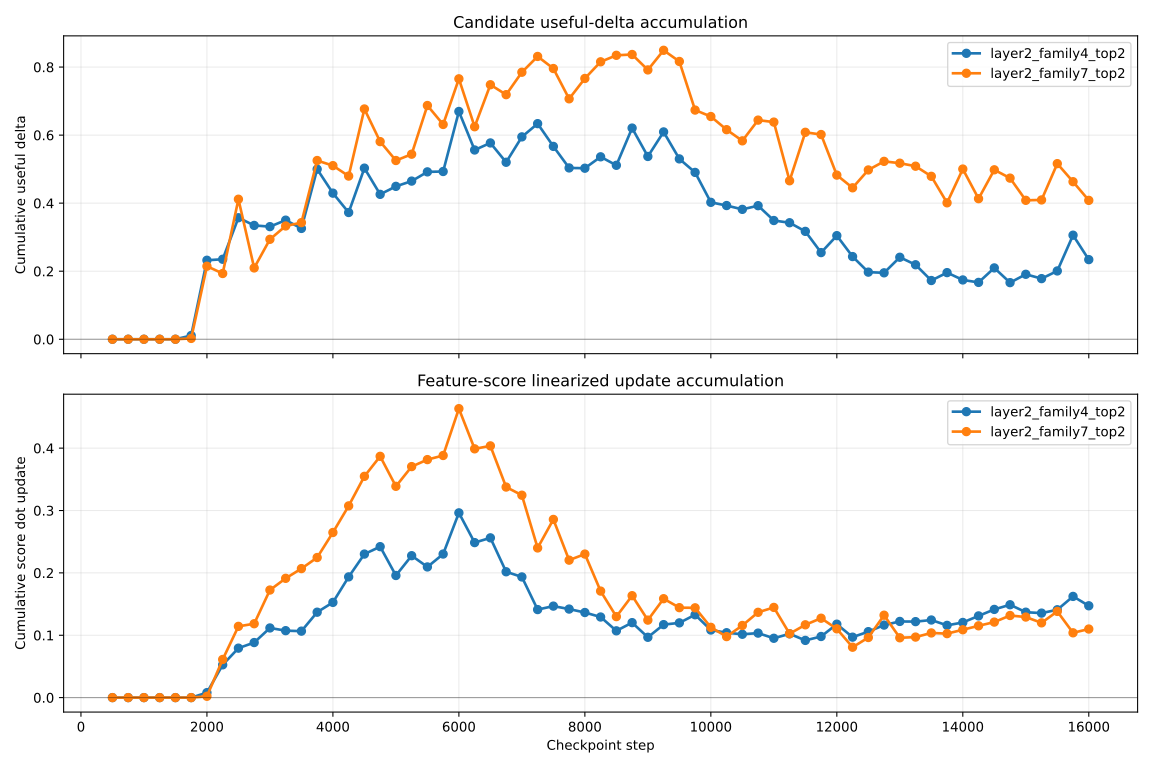
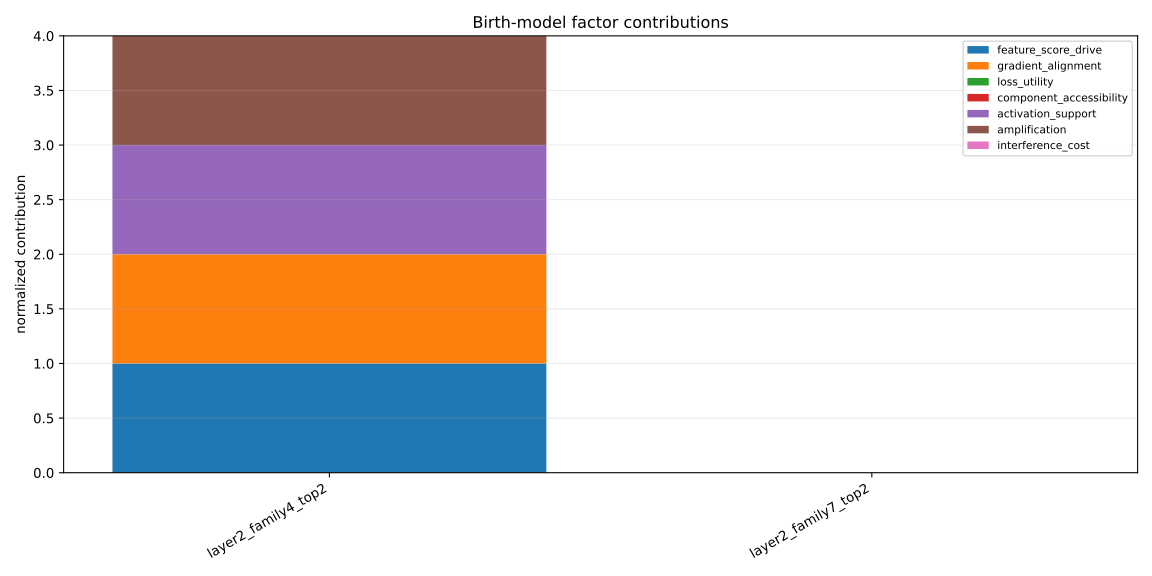
Initial factors:
| factor | intended meaning |
|---|---|
feature_score_drive |
cumulative projected update in candidate feature-score direction |
gradient_alignment |
mean cosine between update and feature-score gradient |
loss_utility |
cumulative loss reduction in candidate parameter scope |
component_accessibility |
candidate update and gradient share relative to global update |
activation_support |
candidate activation level at prediction cutoff |
amplification |
positive pre-birth activation and active-fraction movement |
interference_cost |
negative feature-score and useful movement pressure |
Initial Birth-Model Result
Birth-model report:
artifacts/runs/symbolic_kv_reference_formation/analysis/traced_candidates/layer2_family7_family4/birth_model/candidate_birth_model_report.md
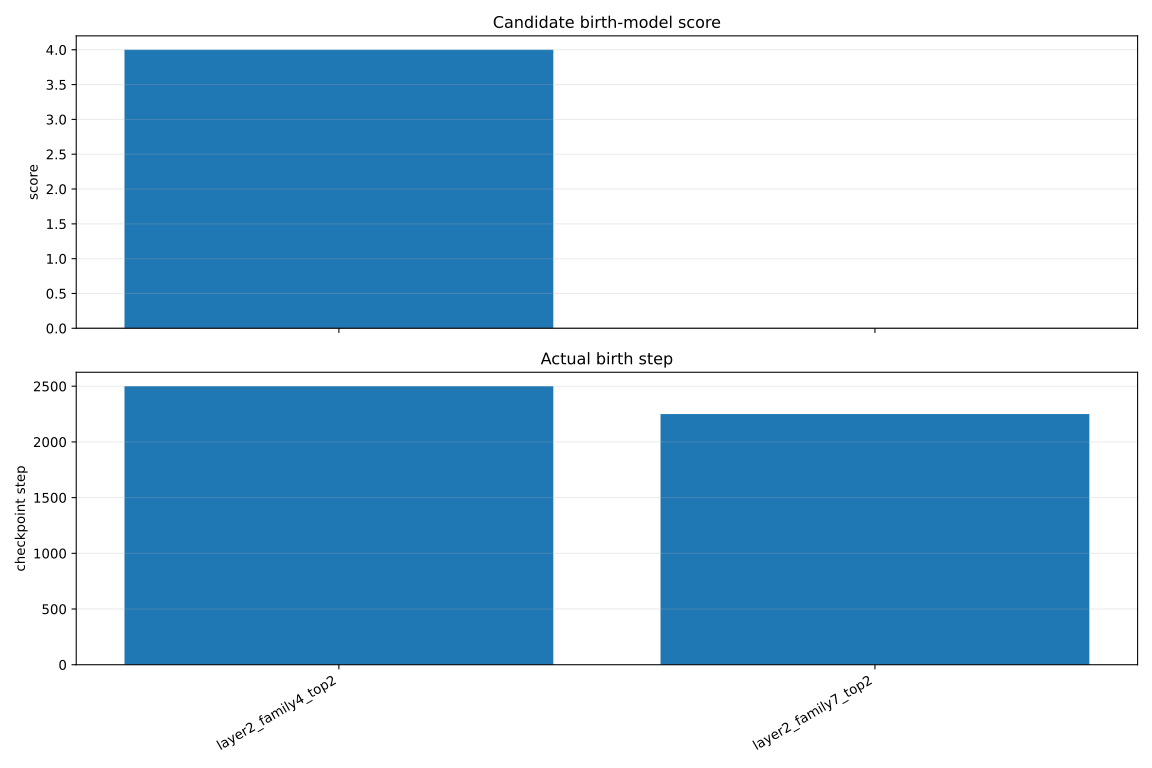
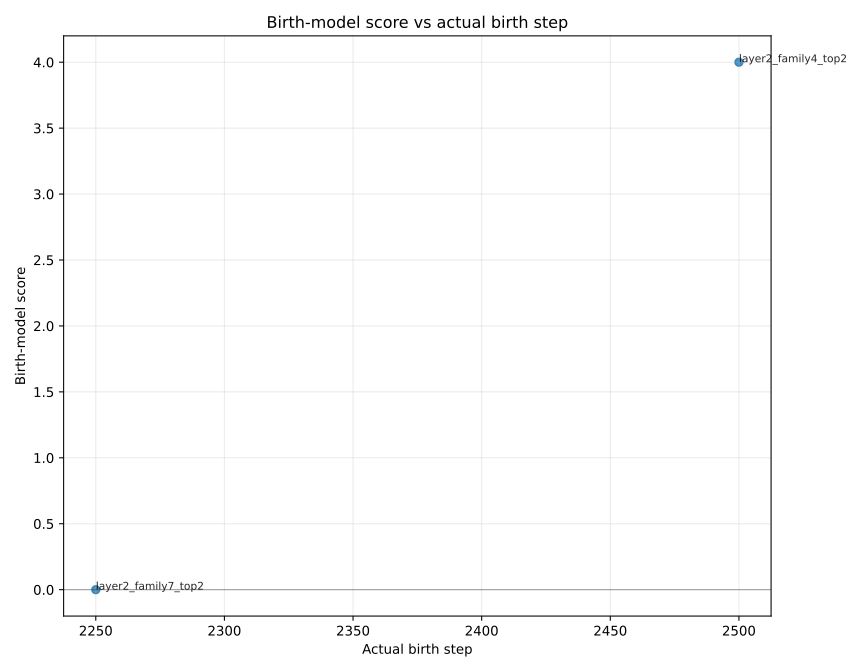
Settings:
| field | value |
|---|---|
| birth metric | useful_birth_step |
| prediction mode | shared_strict_prebirth |
| effective cutoff | 2000 |
| post-birth leakage | false |
Result:
| candidate | birth-model score | predicted rank | actual useful birth | actual rank |
|---|---|---|---|---|
layer2_family4_top2 |
4 |
1 |
2500 |
2 |
layer2_family7_top2 |
0 |
2 |
2250 |
1 |
Negative result:
The first simple birth model predicts family4 over family7. Actual useful birth and heldout generalization favor family7.
Interpretation:
- raw pre-birth feature-score drive is not enough
- activation support is not enough
- family-level sums are hiding important per-feature structure
- the current factor model is missing generalization-specific utility
Next test:
Build per-feature birth models for:
- family7 feature
54 - family7 feature
27 - family4 feature
1 - family4 feature
59
The likely missing distinction is that family7 contains the better generalizing carrier, while family4 contains a stronger but less generalizing amplification signal.
Candidate Coalition Map
The candidate-coalition-map tool was added after the first birth-model failure.
Purpose:
Test whether family7 and family4 are separate circuits,
or two projections of one dense MLP-neuron coalition.
Method:
For each selected checkpoint interval, each candidate, and each selected MLP neuron, the tool computes:
Delta score_c,n ~= grad_theta_n score_c . Delta theta_n
where theta_n is the neuron-specific MLP parameter slice:
fc_inrowfc_inbiasfc_outcolumn
The tool also computes pairwise feature-score gradient cosines restricted to the selected MLP-neuron parameters.
Initial bounded smoke-test report:
artifacts/runs/symbolic_kv_reference_formation/analysis/traced_candidates/layer2_family7_family4/coalition_map_early/candidate_coalition_map_report.md
Settings:
| field | value |
|---|---|
| candidates | layer2_family7_top2, layer2_family4_top2 |
| interval window | 1750 -> 2500 |
| neuron layers | 0, 2 |
| individual features included | f1, f27, f54, f59 |
| device requested first | mps |
| device used for smoke test | cpu, because this execution environment reported MPS unavailable |
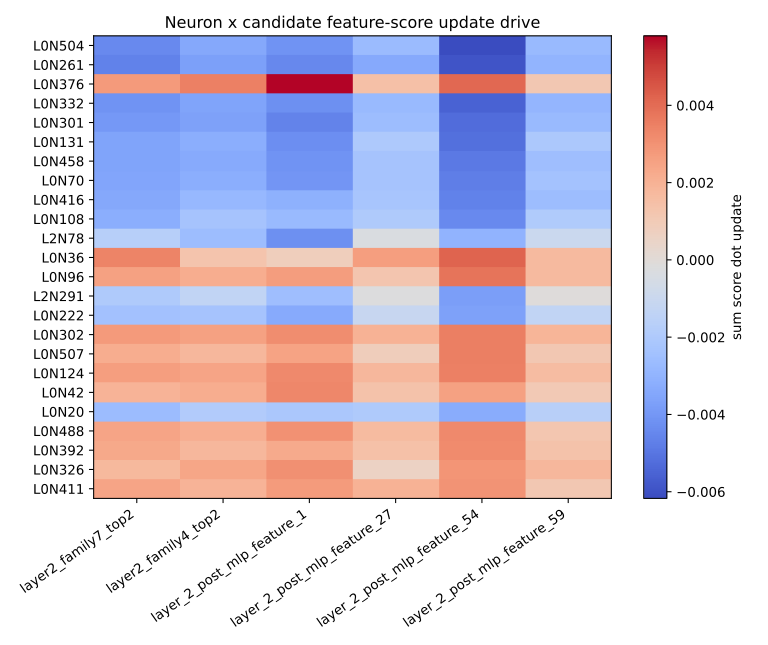
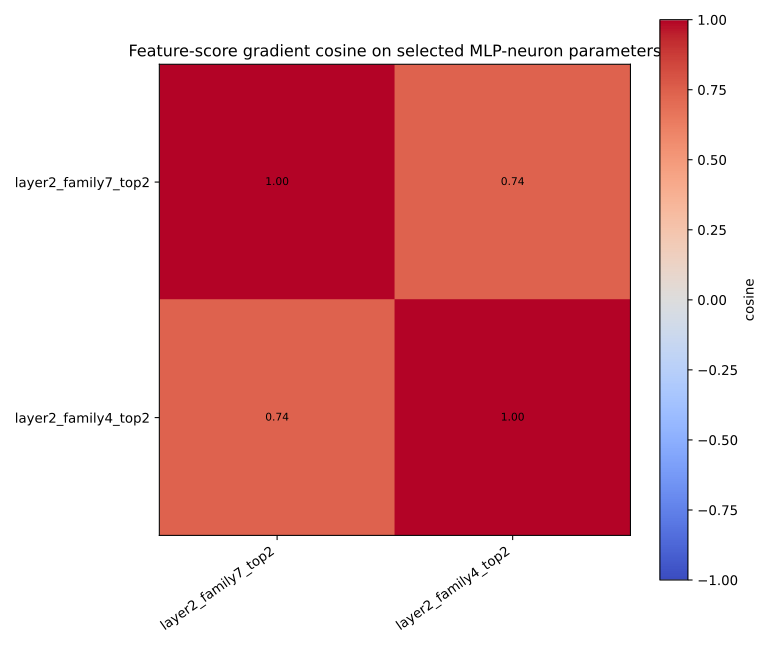
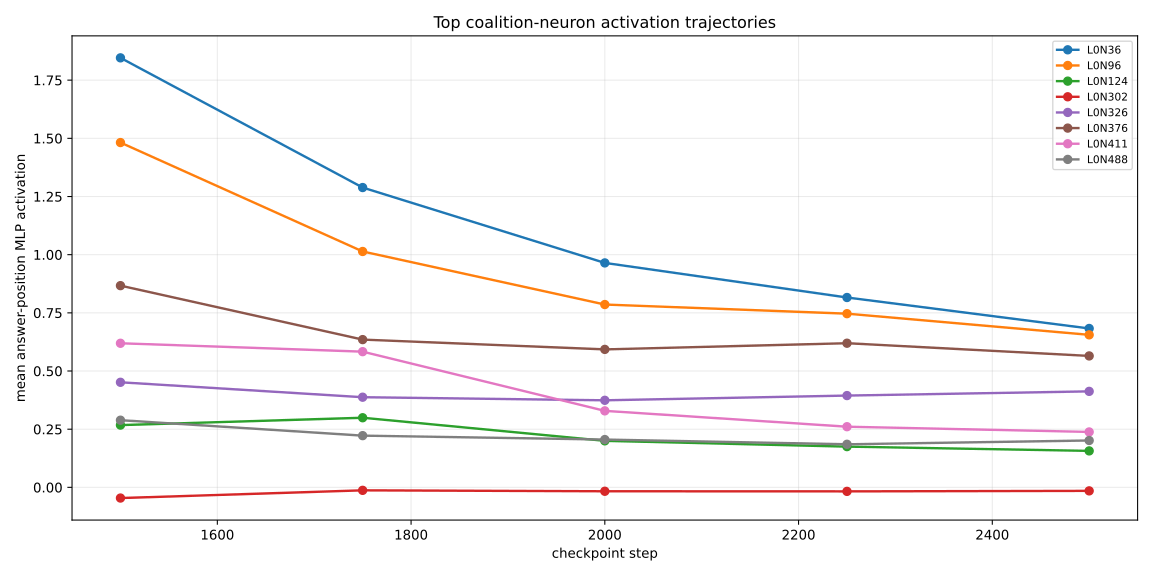
Supported by the bounded smoke test:
- family7 and family4 have strongly positive score-gradient cosine on selected MLP-neuron parameters
- early family7/family4 mean score-gradient cosine is about
0.738 - many neurons are shared-positive for both families under the
1750 -> 2500window f54and family7 are almost identical by this restricted score-gradient cosine, about0.976f1and family4 are also almost identical by this restricted score-gradient cosine, about0.970
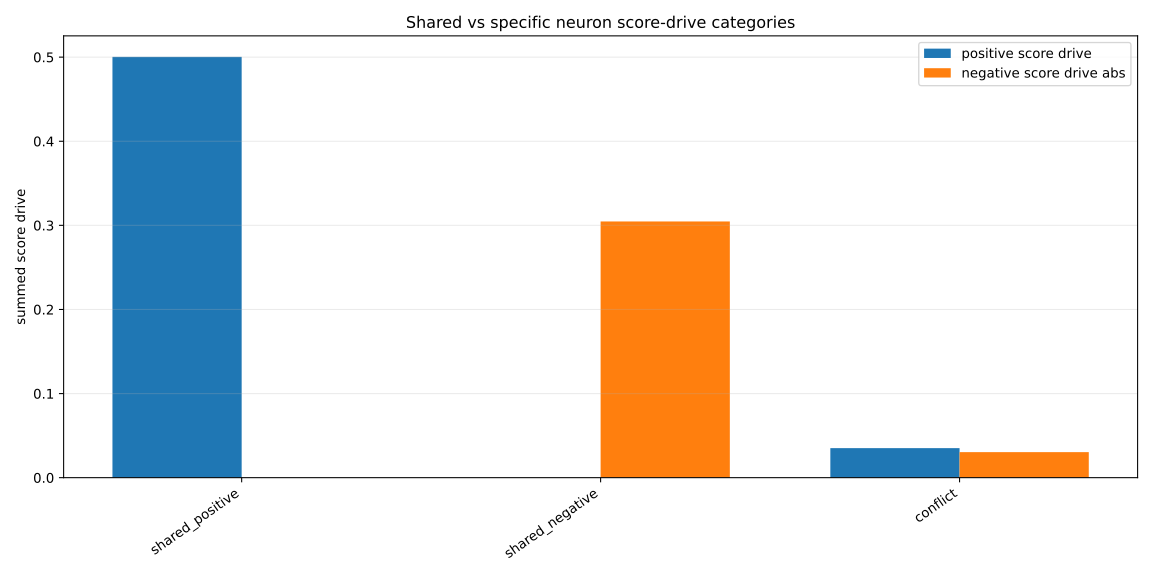
Initial shared/specific category summary:
| category | neurons | positive score | negative score abs |
|---|---|---|---|
| shared positive | 484 |
0.50029 |
0 |
| shared negative | 316 |
0 |
0.304594 |
| conflict | 224 |
0.0351674 |
0.0303447 |
Current best hypothesis:
This is early evidence that family7 and family4 are not separate clean circuits. They are likely sibling readouts of a shared dense MLP-neuron coalition.
Unsupported:
This is not yet a causal necessity result. It does not prove that the shared-positive neurons are necessary for behavior. That requires targeted ablation or patching of:
- top shared-positive neurons
- family7-specific neurons
- family4-specific neurons
- conflict neurons
Candidate Neuron Intervention
The candidate-neuron-intervention tool is the next causal test after the coalition map.
Purpose:
Take the neuron sets discovered by candidate-coalition-map,
zero their MLP hidden activations at a chosen checkpoint,
and measure whether candidate feature scores and task behavior drop.
The tool builds these intervention sets from the coalition map:
shared_positiveconflictshared_negativetop_overlapcandidate_specific:<candidate_id>
The key readout is:
baseline feature score - ablated feature score
If the shared-positive ablation drops both candidate feature-family scores, the dense-coalition hypothesis becomes causal evidence instead of only update-geometry evidence.
Implemented command:
candidate-neuron-intervention
Current outputs:
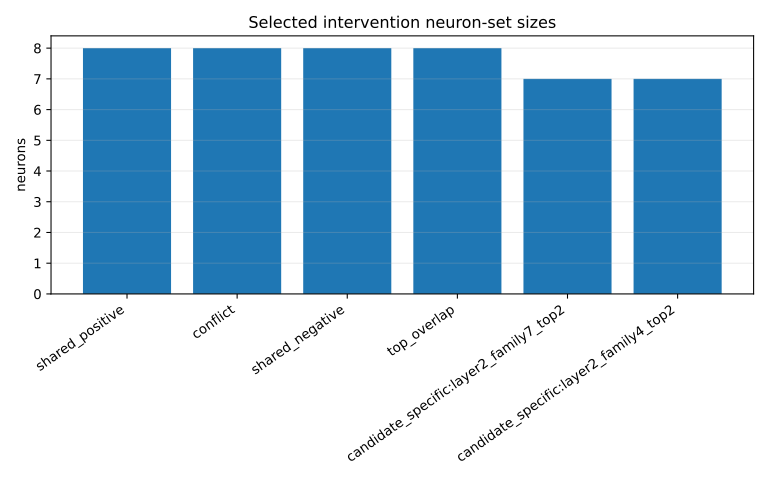
candidate_neuron_intervention_report.jsoncandidate_neuron_intervention_report.mdcandidate_neuron_intervention_behavior.svgcandidate_neuron_intervention_feature_scores.svgcandidate_neuron_intervention_set_sizes.svg- optional
candidate_neuron_intervention_single_neurons.svg
First run:
artifacts/runs/symbolic_kv_reference_formation/analysis/traced_candidates/layer2_family7_family4/neuron_intervention_early_step2500/candidate_neuron_intervention_report.md- checkpoint step:
2500 - device:
mps - top K per set:
8 - individual features included:
f1,f27,f54,f59
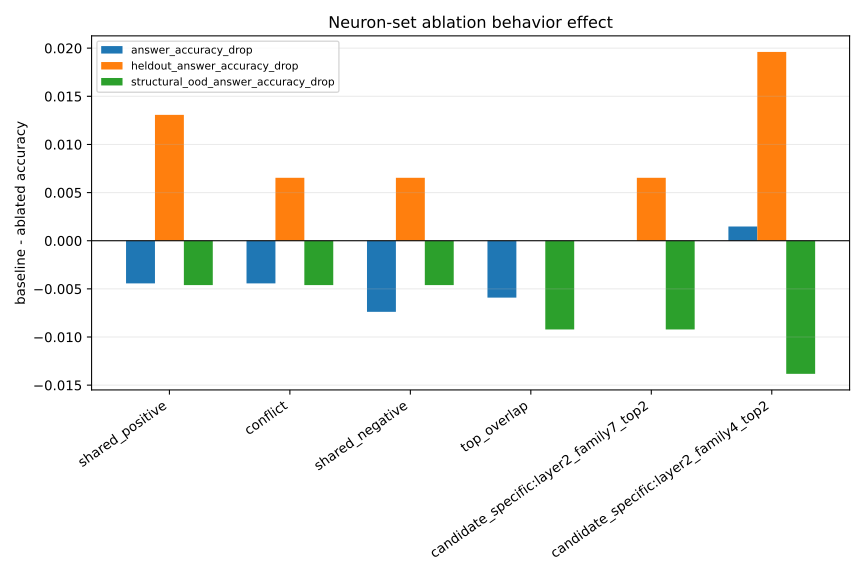
Baseline at checkpoint 2500:
| metric | value |
|---|---|
| loss | 2.45865 |
| token accuracy | 0.489369 |
| answer accuracy | 0.364845 |
| heldout accuracy | 0.104575 |
| structural OOD accuracy | 0.142857 |
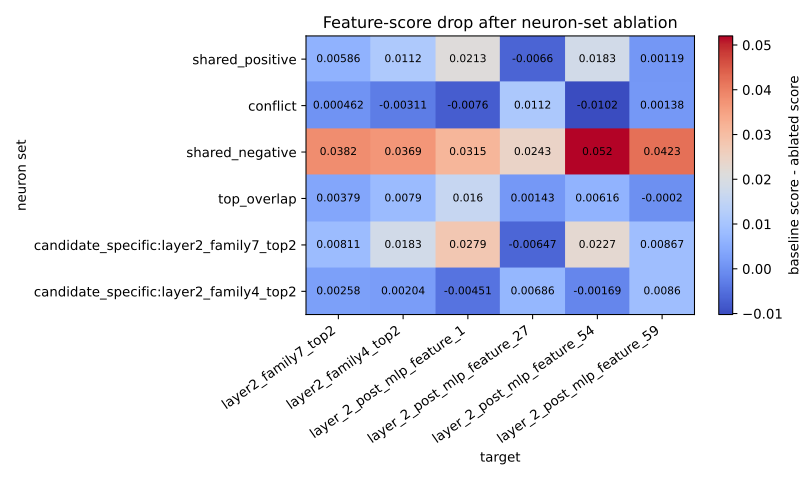
Feature-family score proof:
| ablated set | family4 score drop | family7 score drop | mean candidate score drop | all candidate scores drop |
|---|---|---|---|---|
shared_positive |
0.01124 (5.84%) |
0.00586 (3.19%) |
0.00855 |
true |
top_overlap |
0.00790 (4.10%) |
0.00379 (2.07%) |
0.00584 |
true |
shared_negative |
0.03691 (19.19%) |
0.03818 (20.79%) |
0.03754 |
true |
conflict |
-0.00311 (-1.62%) |
0.00046 (0.25%) |
-0.00133 |
false |
Supported:
- the shared-positive coalition is causally supporting both family feature scores
- the top-overlap set is also a causal shared carrier
- the conflict set behaves like actual internal competition
- the strongest current score carrier is unexpectedly
shared_negative
Important correction:
shared_negative does not mean useless. It means the checkpoint update direction over 1750 -> 2500 pushed against those candidate scores. At checkpoint 2500, those neurons still carry large candidate feature-score signal. This is why a pure “positive update means useful neuron” story fails.
Behavior-level result:
| ablated set | answer drop | heldout drop | structural OOD drop | loss increase |
|---|---|---|---|---|
shared_positive |
-0.00443 |
0.01307 |
-0.00461 |
-0.00062 |
top_overlap |
-0.00591 |
0 |
-0.00922 |
0.00064 |
shared_negative |
-0.00739 |
0.00654 |
-0.00461 |
-0.03991 |
candidate_specific:layer2_family4_top2 |
0.00148 |
0.01961 |
-0.01382 |
-0.00721 |
This is the key limitation:
The neuron intervention proves causal support for feature-family scores, but not clean necessity for final task behavior. The model has compensation, dense overlap, and mixed directions. A neuron-only path can keep producing evidence, but it will not by itself explain why SGD chooses one algorithmic circuit over another.
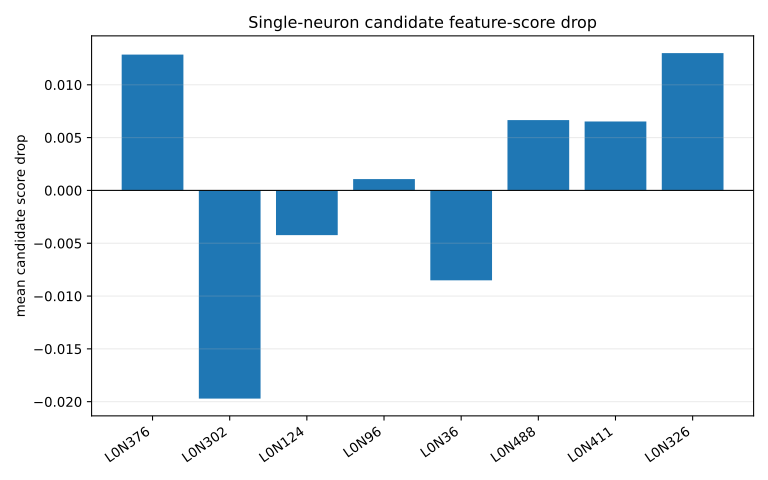
Single-neuron proof inside the shared-positive set:
| neuron | mean candidate score drop | interpretation |
|---|---|---|
L0N326 |
0.012998 |
strong shared support |
L0N376 |
0.012859 |
strong shared support |
L0N488 |
0.006657 |
moderate shared support |
L0N411 |
0.006526 |
moderate shared support |
L0N302 |
-0.019708 |
ablation increases family scores |
L0N36 |
-0.008512 |
ablation increases family scores |
This is direct evidence for dense, internally mixed circuit structure rather than a sparse natural-neuron explanation.
Still unsupported:
- source-to-target neuron activation patching
- causal sufficiency of the shared neurons
- cross-seed intervention stability
Current Research Progress
Supported:
The project has progressed through these stages:
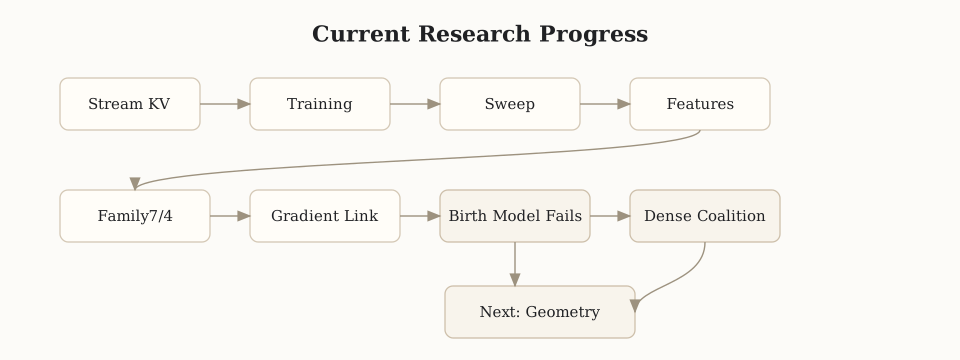
Current status by research layer:
| layer | status | summary |
|---|---|---|
| dataset | Supported | stream KV benchmark is usable and checked |
| model | Supported | small reference transformer trained |
| behavior | Supported | IID and heldout are strong; structural OOD is weak |
| checkpoints | Supported | dense formation run exists |
| birth windows | Supported | early, mid, late windows identified |
| components | Supported | head/MLP/neuron lineage tools exist |
| features | Supported with caveat | shared basis exists, but is dense |
| feature families | Supported with caveat | family7/family4 traced; not final semantic units |
| mechanism report | Supported | current component and phase report exists |
| why model | Negative result | first simple model fails |
| coalition map | Supported | family7/family4 share many MLP neurons and aligned score gradients |
| neuron intervention | Supported with caveat | shared neurons causally drop family scores, but not cleanly task behavior |
| geometric theory | Next test | dataset relation, attention geometry, and path margins not yet decomposed |
| cross-seed | Unsupported | not yet replicated |
| final theory | Unsupported | no closed-form circuit-selection model yet |
Current Blockers
Unsupported:
The project cannot yet claim:
- complete dense circuit decomposition
- natural semantic interpretation of every shared feature
- necessary and sufficient feature family
- cross-seed stability of family7/family4
- per-minibatch SGD trace
- mathematical derivation of why SGD selects family7
Current blockers:
- Family-level aggregation hides per-feature roles.
- The first birth model lacks heldout-specific gradient alignment.
- The current feature basis may be sensitive to SAE hyperparameters.
- Dense overlap means the same components feed multiple families.
- Current neuron interventions affect feature scores more clearly than behavior.
- The same neuron can be update-positive, currently suppressive, and behavior-compensated.
- The current result is one run, not a seed matrix.
- The dataset relation and attention retrieval geometry have not yet been formalized.
Next Research Stages
The earlier next step was “more per-feature birth modeling.” That is still useful, but the intervention result shows it is not the main path to the why question. The current bottleneck is mathematical: we need to understand how the dataset relation becomes geometry inside the model.
Stage 1: Dataset Geometry Report
Next tool:
dataset-geometry-report
Purpose:
Make the relation d(x, y) explicit before looking inside the model.
Needed quantities:
- key identity classes
- value identity classes
- read/write event graph
- latest-value dependency for each read
- distractor key/value structure
- train/heldout/OOD relation matrix
- minimal symbolic algorithm for the benchmark
Question answered:
What geometric structure does the dataset ask SGD to internalize?
Stage 2: Attention Geometry Trace
Next tool:
attention-geometry-trace
Purpose:
Track whether attention heads learn the correct retrieval geometry.
Needed quantities:
- query-to-correct-key attention
- query-to-distractor-key attention
- QK correct-key margin
- attention entropy
- OV value-write score
- direct logit effect of attended value
- role-conditioned attention maps
- QK and OV singular directions
Question answered:
When does the model learn the lookup geometry needed by d(x, y)?
Stage 3: Path Logit Decomposition
Next tool:
path-logit-decomposition
Purpose:
Decompose the answer margin into path-level contributions instead of component lists.
Target expression:
m_t(x, y) ~= sum_P C_P(theta_t, x, y)
Candidate paths:
- embedding to attention to unembedding
- embedding to MLP to attention to unembedding
- attention to MLP to unembedding
- lower MLP to upper MLP to unembedding
- attention to residual feature to MLP readout
Question answered:
Which computational paths carry the correct-answer margin?
Stage 4: Example Gradient Geometry
Next tool:
example-gradient-geometry
Purpose:
Measure which dataset examples push the same internal circuit and which examples interfere.
Needed quantity:
G_ij = <grad_theta L(x_i, y_i), grad_theta L(x_j, y_j)>
Group by:
- same query key
- same answer value
- same write/read relation
- heldout vs train
- correct vs incorrect
- examples that support family7
- examples that support family4
Question answered:
Which parts of the dataset reinforce the same path, and which parts compete?
Stage 5: Mechanism Hypothesis Tester
Next tool:
mechanism-hypothesis-tester
Purpose:
Stop testing vague component sets. Test explicit mathematical circuit hypotheses.
Example hypothesis:
The model solves symbolic KV by learning a QK retrieval head that maps
query-key representations to matching written-key positions, then an OV/value
path writes the associated value into the residual stream, while layer-0 MLP
features shape the key/value subspace used by the later readout.
Required tests:
- QK-only patch
- OV-only patch
- attention path patch
- MLP feature/neuron patch
- path logit recovery
- heldout/OOD recovery
Stage 6: Cross-Seed Replication
Next test:
Repeat the formation run over multiple seeds and compare:
- dataset-geometry readouts
- attention geometry birth
- path contribution birth
- feature families
- neuron coalition categories
- intervention effects
Until this is done, family7 is a current-run candidate, not a universal circuit family.
Current Mathematical Target
Current best target:
Circuit P wins over circuit Q when:

E_D[<grad_theta C_P(theta_t, x, y), -grad_theta L(theta_t, x, y)>]
>
E_D[<grad_theta C_Q(theta_t, x, y), -grad_theta L(theta_t, x, y)>]
subject to:
- architecture constraints
- initialization geometry
- feature superposition
- path interference
- behavioral faithfulness
Unsupported:
This equation is a research target, not yet a supported result.
Artifact Index
Core Configs
configs/benchmark/symbolic_kv_base.jsonconfigs/train/symbolic_kv_generalization.jsonconfigs/train/symbolic_kv_formation.json
Main Runs
artifacts/runs/symbolic_kv_heldout_generalizationartifacts/runs/symbolic_kv_reference_formation
Main Analysis Artifacts
artifacts/runs/symbolic_kv_reference_formation/analysis/checkpoint_metrics.jsonlartifacts/runs/symbolic_kv_reference_formation/analysis/checkpoint_metrics_summary.jsonartifacts/runs/symbolic_kv_reference_formation/analysis/birth_window_analysis.jsonartifacts/runs/symbolic_kv_reference_formation/analysis/shared_features/layer_2_post_mlpartifacts/runs/symbolic_kv_reference_formation/analysis/traced_candidates/layer2_family7_family4
Current Frontier Reports
artifacts/runs/symbolic_kv_reference_formation/analysis/traced_candidates/layer2_family7_family4/mechanism_report/candidate_mechanism_report.mdartifacts/runs/symbolic_kv_reference_formation/analysis/traced_candidates/layer2_family7_family4/birth_model/candidate_birth_model_report.mdartifacts/runs/symbolic_kv_reference_formation/analysis/traced_candidates/layer2_family7_family4/coalition_map_early/candidate_coalition_map_report.mdartifacts/runs/symbolic_kv_reference_formation/analysis/traced_candidates/layer2_family7_family4/neuron_intervention_early_step2500/candidate_neuron_intervention_report.md
Current Conclusion
Supported:
The project now has enough tooling to observe circuit formation at multiple scales:
- behavior
- checkpoint windows
- residual stages
- heads and MLPs
- shared features
- feature families
- candidate circuits
- projected gradient links
- dense neuron coalitions
- targeted neuron ablations
Current best hypothesis:
SGD forms a shared dense retrieval/write coalition first. Family7 and family4 are sibling branches of that coalition. Family7 becomes the more generalizing branch; family4 receives stronger raw pre-birth feature amplification but weaker heldout utility. The coalition is causally real at the feature-score level, but task behavior remains compensated and distributed.
Negative result:
The first pre-birth factor model fails to predict family7 over family4. The first neuron-intervention result proves shared score support but does not cleanly explain behavior. Together, these show that the project has not yet answered the why question.
Next test:
The next decisive step is mathematical geometry: dataset relation, attention QK/OV geometry, path-level logit decomposition, and example-gradient alignment.
The scientific standard from here is:
If a proposed explanation cannot express the dataset relation,
decompose the answer margin, and predict which path SGD reinforces,
it is only a post-hoc story.